Category: Medical Education
Tags: Cardiovascular System, Human Anatomy, Heart, Blood Circulation, Medical Students
Introduction
The cardiovascular system is one of the most important systems in the human body. It is responsible for circulating blood throughout the body, delivering oxygen and nutrients to tissues, and transporting waste products away from cells….
For medical and healthcare students, understanding the cardiovascular system is essential because it forms the foundation for studying conditions such as hypertension, heart failure, coronary artery disease, and other cardiovascular disorders.
In this article, we will explore the major components of the cardiovascular system, how blood circulates through the body, and some important concepts every beginner should understand.
What Is the Cardiovascular System?
The cardiovascular system, also called the circulatory system, consists mainly of three components:
- Heart
- Blood vessels
- Blood
Together, these components work continuously to transport substances throughout the body.
The heart acts as the pump, blood vessels provide the transportation network, and blood carries oxygen, nutrients, hormones, and waste products.
The Heart
The heart is a muscular organ located in the chest between the lungs. Its primary function is to pump blood throughout the body.
The adult human heart has four chambers:
- Right atrium
- Right ventricle
- Left atrium
- Left ventricle
Right Atrium
The right atrium receives oxygen-poor blood returning from the body through the major veins.
Right Ventricle
The right ventricle pumps oxygen-poor blood toward the lungs through the pulmonary arteries.
Left Atrium
The left atrium receives oxygen-rich blood returning from the lungs through the pulmonary veins.
Left Ventricle
The left ventricle pumps oxygen-rich blood into the systemic circulation through the aorta.
The left ventricle has a relatively thick muscular wall because it must generate enough pressure to circulate blood throughout the body.
Heart Valves
Heart valves help ensure that blood flows in the correct direction.
The four major valves are:
- Tricuspid valve
- Pulmonary valve
- Mitral valve
- Aortic valve
These valves open and close according to pressure changes within the heart.
For example, the tricuspid valve allows blood to move from the right atrium to the right ventricle while helping prevent backward flow.
How Blood Circulates Through the Heart
Understanding the pathway of blood through the heart is an important foundation for studying cardiovascular anatomy.
The simplified pathway is:
Body → Right Atrium → Right Ventricle → Lungs → Left Atrium → Left Ventricle → Body
More specifically:
- Oxygen-poor blood returns from the body.
- Blood enters the right atrium.
- It moves into the right ventricle.
- The right ventricle pumps blood to the lungs.
- Blood receives oxygen in the lungs.
- Oxygen-rich blood returns to the left atrium.
- It moves into the left ventricle.
- The left ventricle pumps blood into the aorta.
- Blood is distributed throughout the body.
Blood Vessels
Blood vessels form an extensive network throughout the body.
There are three primary types:
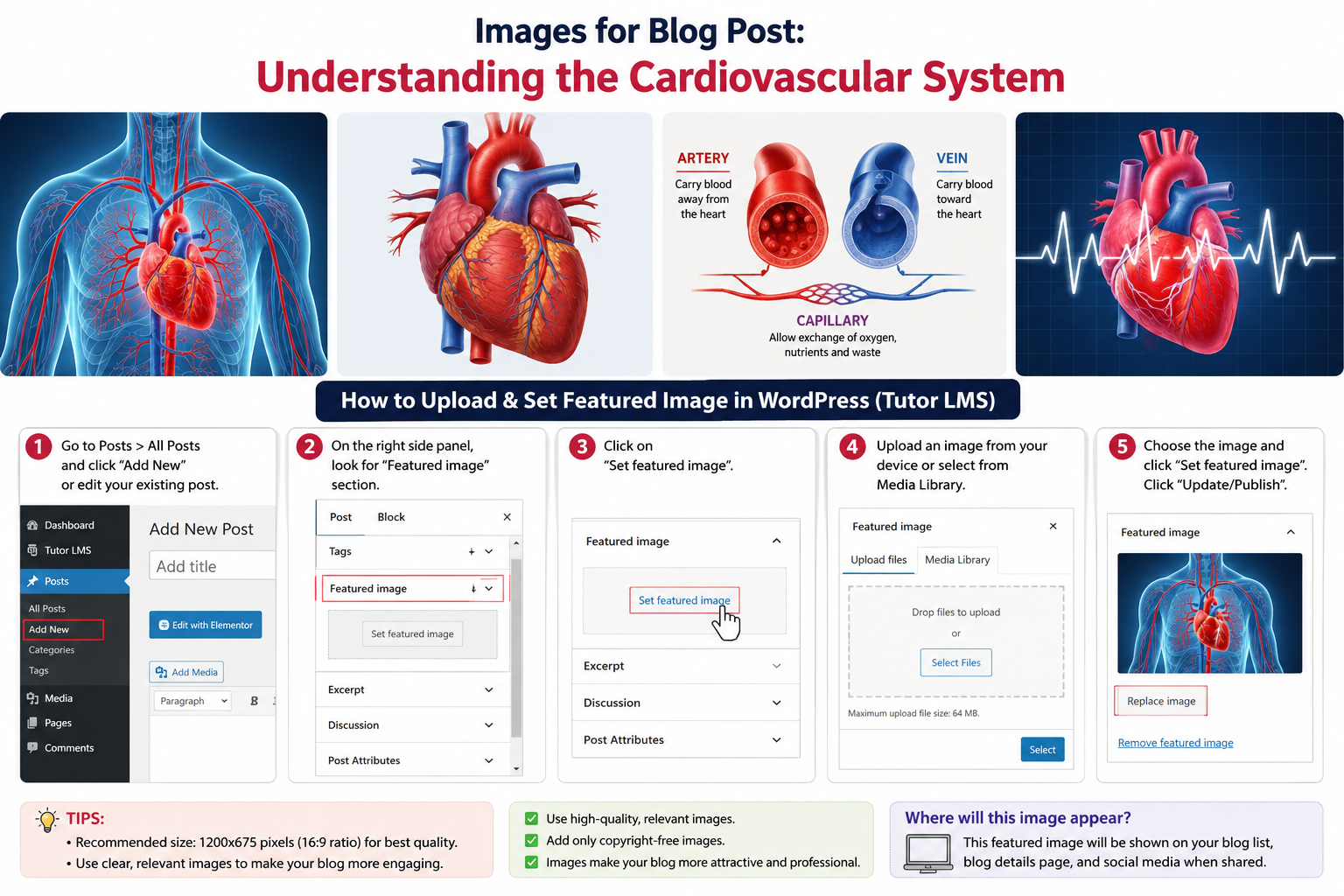
Arteries
Arteries generally carry blood away from the heart.
Most arteries carry oxygen-rich blood. However, the pulmonary arteries are an important exception because they carry oxygen-poor blood from the heart to the lungs.
Veins
Veins generally carry blood toward the heart.
Most veins carry oxygen-poor blood. The pulmonary veins are an important exception because they carry oxygen-rich blood from the lungs to the heart.
Capillaries
Capillaries are very small blood vessels that connect the arterial and venous sides of circulation.
They are important sites for the exchange of:
- Oxygen
- Carbon dioxide
- Nutrients
- Waste products
- Other substances between blood and tissues
Pulmonary and Systemic Circulation
The cardiovascular system can be broadly divided into two major circulation pathways.
Pulmonary Circulation
Pulmonary circulation carries blood between the heart and lungs.
Its primary purpose is to allow blood to exchange carbon dioxide for oxygen.
Right ventricle → Pulmonary arteries → Lungs → Pulmonary veins → Left atrium
Systemic Circulation
Systemic circulation carries oxygen-rich blood from the heart to the body’s tissues and returns oxygen-poor blood back to the heart.
Left ventricle → Aorta → Body tissues → Veins → Right atrium
Understanding the difference between pulmonary and systemic circulation is essential for learning cardiovascular physiology.
What Is Blood Pressure?
Blood pressure is the force exerted by circulating blood against the walls of blood vessels.
It is commonly represented using two numbers:
- Systolic pressure — pressure when the heart contracts.
- Diastolic pressure — pressure when the heart relaxes between beats.
Blood pressure is an important clinical measurement because abnormal blood pressure can be associated with various cardiovascular conditions.
Heart Rate
Heart rate refers to the number of times the heart beats per minute.
The heart’s rhythm is coordinated by its electrical conduction system.
Important structures include:
- Sinoatrial (SA) node
- Atrioventricular (AV) node
- Bundle of His
- Bundle branches
- Purkinje fibers
The SA node normally acts as the heart’s natural pacemaker and initiates electrical impulses that help coordinate the heartbeat.
Coronary Circulation
The heart itself requires oxygen and nutrients to function. These are supplied by the coronary arteries.
Coronary arteries arise from the aorta and supply blood to the heart muscle.
If blood flow through a coronary artery becomes significantly restricted, the heart muscle may not receive enough oxygen.
This is an important concept when studying conditions such as coronary artery disease and myocardial infarction.
Why Is the Cardiovascular System Important?
The cardiovascular system performs several essential functions, including:
- Delivering oxygen to tissues
- Transporting nutrients
- Removing metabolic waste
- Transporting hormones
- Helping regulate body temperature
- Supporting immune responses
- Maintaining circulation and tissue perfusion
Because virtually every organ depends on adequate blood supply, cardiovascular health is essential for overall health.
Tips for Medical Students
The cardiovascular system can initially seem complicated because it combines anatomy, physiology, and clinical concepts.
Here are some useful study strategies:
1. Memorize the Blood Flow Pathway
Start by learning:
Body → Right Heart → Lungs → Left Heart → Body
Once this pathway is clear, many cardiovascular concepts become easier.
2. Study the Heart With Diagrams
Use labeled diagrams to identify the chambers, valves, major vessels, and coronary arteries.
3. Understand Before Memorizing
Rather than simply memorizing the names of structures, understand what each structure does and where blood moves next.
4. Connect Anatomy With Clinical Medicine
After learning normal cardiovascular anatomy, relate it to common conditions such as hypertension, heart failure, arrhythmias, and coronary artery disease.
Conclusion
The cardiovascular system is a complex but highly organized network responsible for maintaining continuous blood circulation throughout the body.
Understanding the heart chambers, valves, blood vessels, circulation pathways, blood pressure, and electrical conduction system provides a strong foundation for further study in physiology and clinical medicine.
For beginners, the best approach is to learn the system step by step, beginning with the structure of the heart and the pathway of blood before moving into more advanced cardiovascular physiology and disease processes.