Category: Pharmacology
Tags: Pharmacology Basics, Pharmacology, Medicines, Drug Classification, Medical Students, Nursing Students, Healthcare Education
Introduction
Pharmacology is the science of drugs and their effects on living organisms. It is an essential subject for medical, nursing, pharmacy, and other healthcare students.
At first, pharmacology can seem difficult because there are many drug names, classifications, mechanisms, side effects, and dosage concepts to remember. However, understanding a few basic principles makes the subject much easier.
In this beginner-friendly guide, we will introduce the fundamental concepts of pharmacology and explain how medicines interact with the human body.
Important: This article is for educational purposes. Medication selection, dosage, and treatment decisions should always be made by qualified healthcare professionals.
What Is Pharmacology?
Pharmacology is the study of drugs, including:
- How drugs work
- How drugs enter and leave the body
- How drugs produce their effects
- How drugs are used to treat diseases
- Side effects and adverse reactions
- Drug interactions
- Safe and appropriate use of medicines
Pharmacology connects basic sciences such as physiology and biochemistry with clinical medicine.
Pharmacology vs Pharmacy
These two terms are related but different.
Pharmacology
Focuses primarily on the scientific study of drugs and their effects.
Pharmacy
Focuses on the preparation, dispensing, management, and appropriate use of medicines.
A simple way to remember this is:
Pharmacology = Study of drugs
Pharmacy = Practice involving medicines
What Is a Drug?
A drug is a substance that can produce a biological effect when introduced into the body.
Drugs may be used to:
- Prevent disease
- Diagnose disease
- Treat disease
- Control symptoms
- Replace substances that the body lacks
Examples include medicines used for pain, infections, high blood pressure, diabetes, allergies, and many other conditions.
Drug Names
A medicine can have several names.
Chemical Name
The chemical name describes the molecular structure of the substance.
It is generally not the name most patients or healthcare professionals use in routine practice.
Generic Name
The generic name identifies the active medicine.
Examples include:
- Paracetamol
- Amoxicillin
- Metformin
- Amlodipine
Brand Name
A pharmaceutical company may market a medicine under a specific brand name.
The same active ingredient may therefore be sold under different brand names by different manufacturers.
Study Tip
For pharmacology students, learning the generic name first is usually more useful than memorizing many brand names.
Pharmacokinetics and Pharmacodynamics
Two fundamental concepts in pharmacology are:
Pharmacokinetics
and
Pharmacodynamics
Understanding the difference between them is extremely important.
What Is Pharmacokinetics?
Pharmacokinetics describes what the body does to a drug.
It is commonly remembered using:
ADME
A — Absorption
D — Distribution
M — Metabolism
E — Excretion
1. Absorption
Absorption is the process by which a drug enters the bloodstream from its site of administration.
For example, after swallowing an oral tablet, the active ingredient must be released and absorbed through the gastrointestinal tract before it can reach the systemic circulation.
Absorption can be influenced by:
- Route of administration
- Food
- Drug formulation
- Gastrointestinal function
- Other medicines
2. Distribution
After entering the bloodstream, a drug is distributed throughout the body.
Distribution can be influenced by factors such as:
- Blood flow
- Tissue characteristics
- Protein binding
- Body composition
Different drugs distribute differently throughout the body.
3. Metabolism
Metabolism is the chemical modification of drugs within the body.
The liver is an important site of drug metabolism, although other organs and tissues can also contribute.
Metabolism can make drugs easier to eliminate from the body.
Some medicines are also converted into active or inactive metabolites during this process.
4. Excretion
Excretion is the removal of drugs or their metabolites from the body.
The kidneys play a major role in drug excretion.
Other routes can include:
- Bile and feces
- Exhaled air
- Sweat
- Breast milk
Kidney function is therefore important when considering the use and dosing of some medicines.
What Is Pharmacodynamics?
Pharmacodynamics describes what a drug does to the body.
It focuses on:
- Drug effects
- Mechanisms of action
- Drug-receptor interactions
- Dose-response relationships
- Therapeutic effects
- Adverse effects
A simple way to remember the difference is:
Pharmacokinetics = What the body does to the drug
Pharmacodynamics = What the drug does to the body
Drug Receptors
Many medicines produce their effects by interacting with receptors.
A receptor is a biological structure, often a protein, that can recognize and respond to particular molecules.
When a drug interacts with a receptor, it may:
- Activate the receptor
- Block the receptor
- Modify its activity
Understanding receptors helps explain how many medicines produce their therapeutic effects.
Agonists and Antagonists
Agonist
An agonist binds to a receptor and activates it to produce a response.
Antagonist
An antagonist binds to a receptor and blocks or reduces the action of an agonist.
These concepts are fundamental when learning drug mechanisms.
Routes of Drug Administration
Medicines can be administered through different routes.
Oral
Medicine is taken by mouth.
Examples:
- Tablets
- Capsules
- Syrups
Oral administration is convenient and commonly used.
Intravenous
The medicine is administered directly into a vein.
This can produce a rapid systemic effect.
Intramuscular
The medicine is injected into a muscle.
Subcutaneous
The medicine is injected into the tissue beneath the skin.
Topical
The medicine is applied to the skin or another external surface.
Inhalation
The medicine is delivered through the respiratory system.
The appropriate route depends on the medicine and clinical situation.
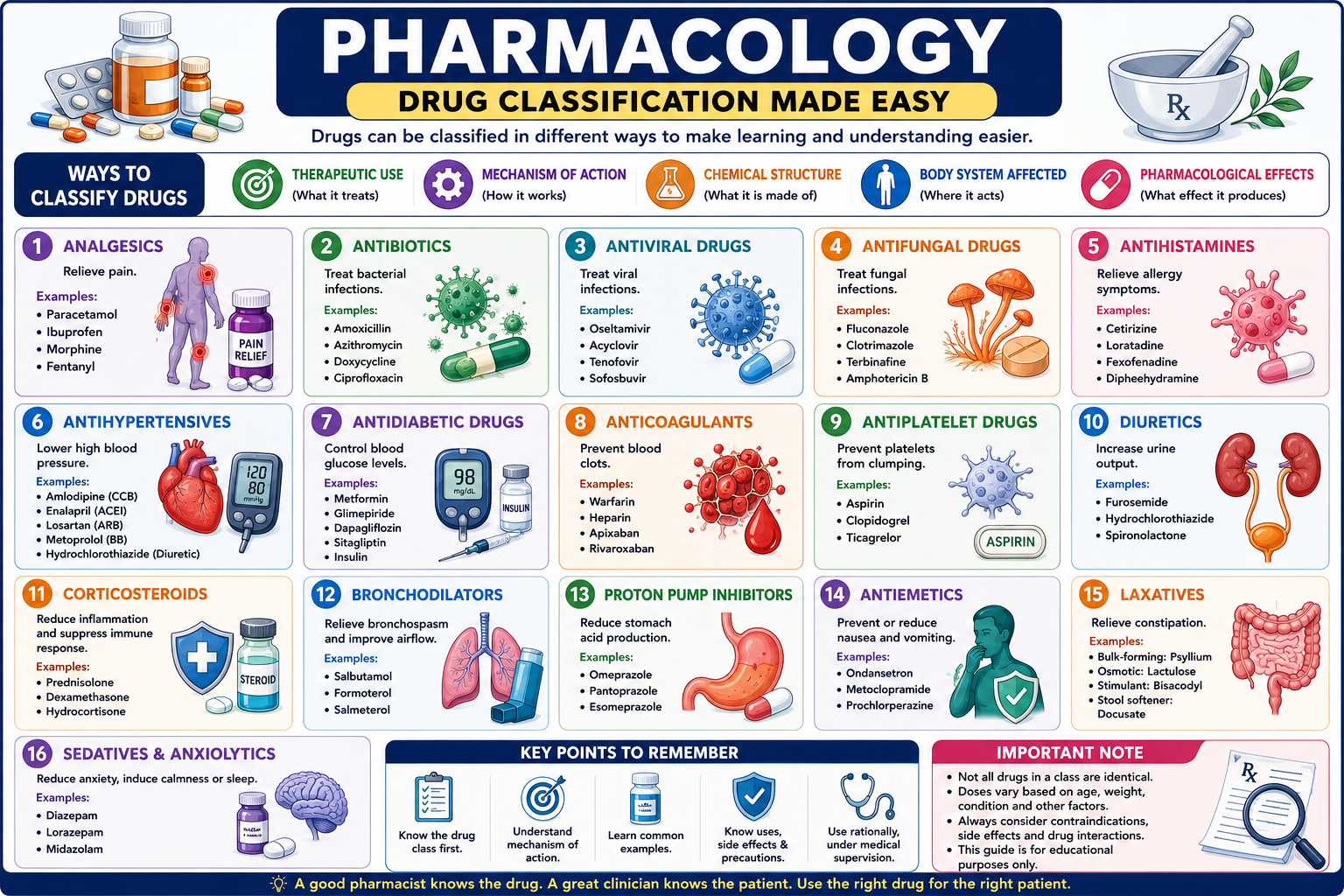
Drug Classification
Medicines can be classified in several ways.
They may be grouped according to:
- Therapeutic use
- Mechanism of action
- Chemical structure
- Body system affected
Some common drug classes include:
Analgesics
Used for pain relief.
Antibiotics
Used to treat certain bacterial infections.
Antihypertensives
Used to manage high blood pressure.
Antidiabetic Medicines
Used to control blood glucose.
Antihistamines
Used for certain allergic conditions.
Anticoagulants
Reduce the ability of blood to form certain clots.
Corticosteroids
Have anti-inflammatory and immunosuppressive effects.
Learning drug classes makes it easier to organize large numbers of medicines.
Therapeutic Effect
The therapeutic effect is the intended beneficial effect of a medicine.
For example, the intended effect of an analgesic may be to reduce pain.
The therapeutic effect depends on factors such as:
- Drug
- Dose
- Route
- Patient characteristics
- Disease being treated
Side Effects and Adverse Drug Reactions
Medicines can produce effects other than their intended therapeutic effect.
Side Effect
A secondary effect that can occur when a medicine is used at normal doses.
Adverse Drug Reaction
An unwanted and potentially harmful response associated with appropriate drug use.
The severity of adverse effects can range from mild to serious.
Healthcare professionals need to understand the potential risks of medicines and monitor patients appropriately.
Drug Interactions
A drug interaction occurs when one drug affects the action or effects of another drug.
Interactions can also occur between medicines and:
- Food
- Alcohol
- Supplements
- Herbal products
- Certain diseases
Drug interactions may increase toxicity, reduce effectiveness, or change the expected response.
This is why a complete medication history is important.
Factors That Affect Drug Response
The same medicine may not produce exactly the same response in every person.
Important factors include:
- Age
- Body weight
- Kidney function
- Liver function
- Genetics
- Other medicines
- Medical conditions
- Route of administration
- Dose
For this reason, medication treatment should be individualized when appropriate.
Dose and Dosage
These terms are related but should not be confused.
Dose
The amount of medicine administered at one time.
Dosage
The overall plan describing how much medicine should be taken, how often, and sometimes for how long.
For example, a prescription may specify a particular dose to be taken at a particular frequency.
Always follow the prescribed instructions rather than changing the dose independently.
Therapeutic Index
The therapeutic index is a concept used to describe the relationship between effective and toxic drug concentrations or doses.
A medicine with a relatively narrow therapeutic range may require particularly careful dosing and monitoring.
This concept helps students understand why some medicines require closer monitoring than others.
Half-Life
The half-life of a drug is the time required for the amount or concentration of the drug in the body to decrease by approximately half under the defined pharmacokinetic conditions.
Half-life can influence:
- How frequently a medicine is administered
- How long its effects may last
- How long it takes to reach steady state
- How long it may take to leave the body
Understanding half-life becomes especially useful when studying dosing schedules.
Why Pharmacology Is Important
Pharmacology helps healthcare professionals understand:
- Which medicines are appropriate for particular conditions
- How medicines work
- How medicines should be administered
- Potential adverse effects
- Drug interactions
- Contraindications
- Monitoring requirements
- Medication safety
A strong foundation in pharmacology supports safer clinical practice.
How Beginners Should Study Pharmacology
Pharmacology can become overwhelming if you try to memorize every drug individually.
Instead, use a structured approach.
Step 1: Learn the Drug Class
For example:
ACE inhibitors
Step 2: Understand the Mechanism
Learn how the class produces its effects.
Step 3: Learn Representative Drugs
Start with a few commonly used generic medicines.
Step 4: Learn Therapeutic Uses
Understand which conditions the medicines are commonly used for.
Step 5: Learn Important Adverse Effects
Focus on clinically significant effects.
Step 6: Learn Contraindications and Precautions
Understand situations where the medicine may be inappropriate or require special care.
Step 7: Learn Monitoring
Understand what clinical signs or laboratory tests may need to be monitored.
This approach is much more effective than memorizing long lists of drug names.
A Simple Pharmacology Study Framework
For every medicine you study, ask these seven questions:
1. What is the drug?
2. Which class does it belong to?
3. How does it work?
4. What is it used for?
5. What are the important adverse effects?
6. What are the major precautions or contraindications?
7. What monitoring may be required?
If you can answer these questions, you have a strong basic understanding of that medicine.
Quick Pharmacology Revision
| Concept | Simple Meaning |
|---|---|
| Pharmacology | Study of drugs |
| Pharmacokinetics | What the body does to the drug |
| Pharmacodynamics | What the drug does to the body |
| Absorption | Drug enters the bloodstream |
| Distribution | Drug moves through the body |
| Metabolism | Drug is chemically modified |
| Excretion | Drug leaves the body |
| Agonist | Activates a receptor |
| Antagonist | Blocks/reduces receptor activation |
| Therapeutic effect | Intended beneficial effect |
| Side effect | Secondary effect |
| Drug interaction | One substance affects another |
| Half-life | Time for drug amount/concentration to decrease by half |
Conclusion
Pharmacology becomes much easier when the basic concepts are understood first.
Start with the difference between pharmacokinetics and pharmacodynamics, learn ADME, understand drug receptors, study drug classifications, and then learn individual medicines using a consistent framework.
Rather than memorizing hundreds of drug names, focus on understanding:
Drug class → Mechanism → Uses → Adverse effects → Precautions → Monitoring
This foundation will make advanced pharmacology and clinical medicine much easier to understand.
Learn the principles first, then build your knowledge of individual medicines step by step.