Category: Emergency Medicine
Tags: Medical Emergencies, First Aid, Emergency Management, CPR, Healthcare Professionals, Medical Students, Emergency Medicine
Introduction
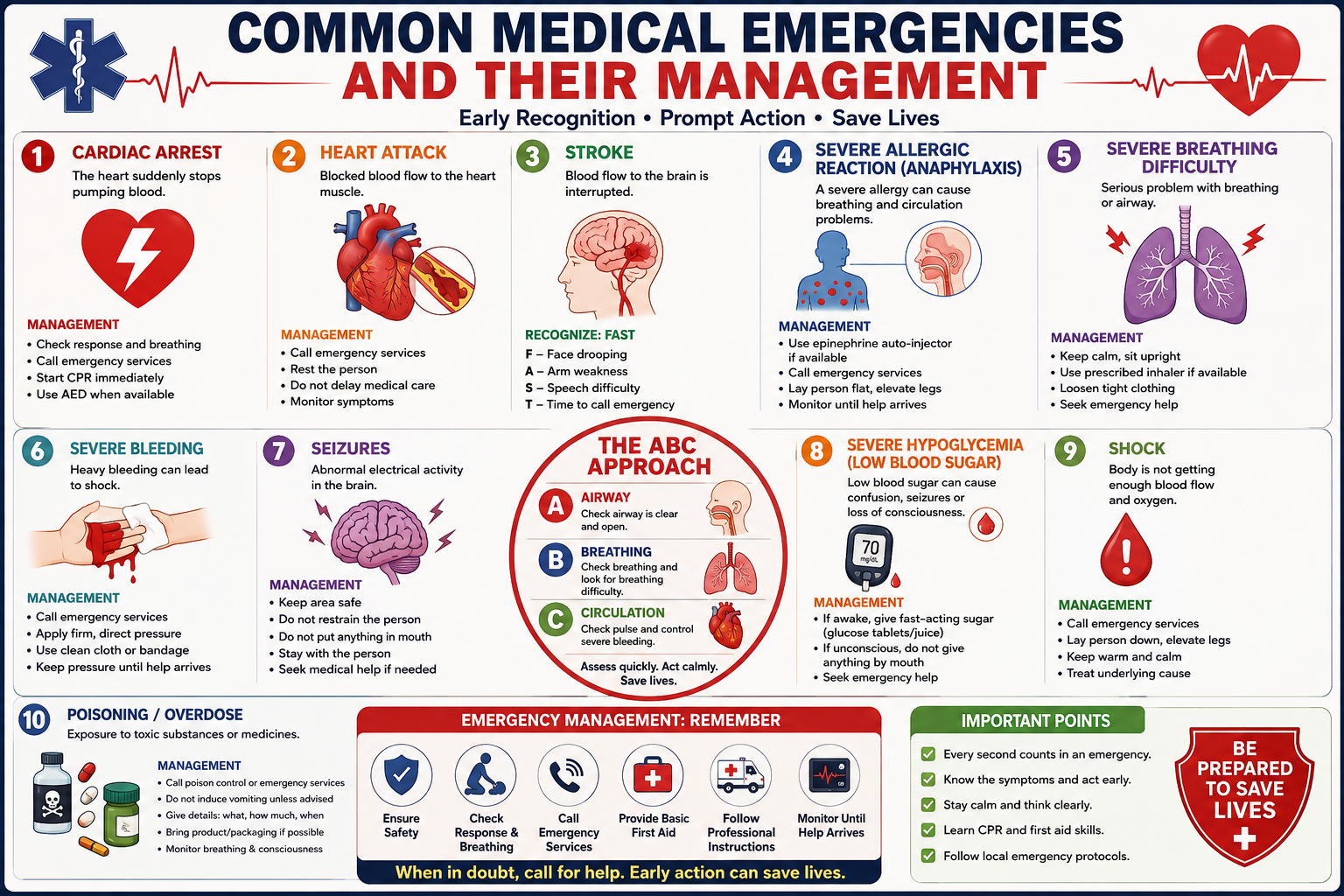
Medical emergencies can occur suddenly and may require immediate assessment and treatment. Recognizing the warning signs of a serious condition and responding appropriately can help reduce complications and improve outcomes.
Healthcare professionals and students should understand the basic principles of emergency assessment, prioritization, and initial management.
This article provides an educational overview of common medical emergencies and the general principles used in their initial management. It is not a substitute for professional medical training or local emergency protocols.
What Is a Medical Emergency?
A medical emergency is a condition that may pose an immediate threat to a person’s life or major bodily functions and requires prompt medical attention.
Examples include:
- Cardiac arrest
- Heart attack
- Stroke
- Severe allergic reaction
- Severe breathing difficulty
- Severe bleeding
- Seizures
- Severe hypoglycemia
- Shock
- Poisoning or overdose
Early recognition and appropriate action are important in all of these situations.
1. Cardiac Arrest
Cardiac arrest occurs when the heart suddenly stops effectively pumping blood.
Warning Signs
A person experiencing cardiac arrest may:
- Become unresponsive
- Stop breathing normally
- Collapse suddenly
Initial Management
If cardiac arrest is suspected:
- Check that the scene is safe.
- Check whether the person responds.
- Assess breathing.
- Activate emergency medical services.
- Begin CPR if appropriate and follow local CPR guidance.
- Use an automated external defibrillator (AED) when available and follow its instructions.
Rapid CPR and defibrillation when indicated can be critical.
2. Heart Attack
A heart attack, or myocardial infarction, occurs when blood flow to part of the heart muscle becomes blocked or severely reduced.
Common Symptoms
Symptoms can include:
- Chest pressure, pain, or discomfort
- Pain or discomfort spreading to the arm, shoulder, back, neck, or jaw
- Shortness of breath
- Sweating
- Nausea
- Unusual weakness or fatigue
Symptoms can vary between individuals.
Initial Management
A suspected heart attack requires urgent medical evaluation.
The person should stop exertion and seek emergency medical assistance. Do not delay emergency care while trying home remedies.
Healthcare professionals may perform an ECG and other investigations to determine the cause of symptoms and guide treatment.
3. Stroke
A stroke occurs when blood flow to part of the brain is interrupted or when bleeding occurs within the brain.
Recognizing a Stroke
A useful approach is FAST:
F — Face:
Ask the person to smile. Is one side of the face drooping?
A — Arms:
Ask the person to raise both arms. Is one arm weak or drifting downward?
S — Speech:
Is speech unclear, unusual, or difficult to understand?
T — Time:
Treat the situation as an emergency and seek medical help immediately.
Other symptoms can include sudden vision problems, dizziness, difficulty walking, confusion, or a severe headache.
Initial Management
Call emergency medical services immediately.
Note the time when symptoms were first noticed, if known. Do not give food, drink, or medication unless instructed by a qualified healthcare professional.
4. Severe Allergic Reaction
A severe allergic reaction, known as anaphylaxis, can develop rapidly and may affect breathing and circulation.
Possible Symptoms
Symptoms may include:
- Difficulty breathing
- Swelling of the lips, tongue, or throat
- Wheezing
- Widespread hives
- Dizziness or fainting
- Low blood pressure
- Rapid deterioration
Initial Management
Anaphylaxis requires immediate emergency treatment.
If the person has a prescribed epinephrine/adrenaline auto-injector, it should be used according to their emergency action plan and device instructions.
Emergency medical services should be contacted immediately, even if symptoms begin to improve.
5. Severe Breathing Difficulty
Breathing difficulty can result from conditions such as asthma, severe allergic reactions, pneumonia, airway obstruction, or heart problems.
Warning Signs
Seek urgent medical attention when a person has:
- Severe difficulty breathing
- Blue or gray lips or skin
- Inability to speak normally because of breathlessness
- Severe wheezing or noisy breathing
- Confusion or reduced consciousness
- Rapid deterioration
Initial Management
Keep the person in a position that makes breathing easier and seek emergency medical assistance.
If the person has a prescribed rescue medication, such as an asthma inhaler, help them use it according to their existing medical instructions.
6. Severe Bleeding
Severe bleeding can become life-threatening if blood loss is significant.
Signs
Possible signs include:
- Continuous or heavy bleeding
- Blood rapidly soaking through clothing or dressings
- Weakness or dizziness
- Pale or clammy skin
- Loss of consciousness
Initial Management
If it is safe to do so:
- Call emergency medical services.
- Apply firm, direct pressure to the wound using appropriate material.
- Continue pressure and do not repeatedly remove dressings to check the wound.
- Follow emergency responder instructions.
For life-threatening limb bleeding, trained responders may use a tourniquet according to appropriate emergency protocols.
7. Seizures
A seizure can cause sudden changes in awareness, movement, sensation, or behavior.
During a generalized convulsive seizure, the person may become unconscious and experience uncontrolled movements.
What To Do
During a seizure:
- Keep the surrounding area safe.
- Move dangerous objects away.
- Protect the person’s head if possible.
- Do not restrain the person.
- Do not put anything in their mouth.
- Do not give food or drink until they are fully alert.
- After the seizure, monitor their breathing and stay with them.
Seek emergency medical assistance when the seizure is prolonged, repeats without recovery, occurs in water, causes serious injury, involves breathing difficulties, or occurs in someone who is pregnant or has another significant medical concern.
8. Severe Hypoglycemia
Hypoglycemia means that blood glucose is too low. It can occur particularly in people using certain diabetes medications.
Possible Symptoms
Early symptoms may include:
- Sweating
- Shaking
- Hunger
- Dizziness
- Irritability
- Confusion
- Weakness
Severe hypoglycemia can cause seizures or loss of consciousness.
Initial Management
If the person is awake and able to swallow safely, appropriate fast-acting carbohydrate may be given according to their diabetes care plan.
If the person is unconscious or unable to swallow safely, do not give food or drink by mouth. Seek emergency medical assistance and follow the person’s emergency diabetes plan if available.
9. Shock
Shock occurs when the body’s tissues do not receive adequate blood flow and oxygen.
It can result from severe bleeding, infection, major injury, severe allergic reactions, or other serious conditions.
Possible Signs
A person in shock may have:
- Pale or clammy skin
- Rapid breathing
- Weakness
- Dizziness
- Confusion
- Rapid pulse
- Reduced consciousness
Initial Management
Shock is a medical emergency.
Call emergency medical services and address the underlying cause if trained to do so. Keep the person warm and monitor their breathing and responsiveness while waiting for professional help.
10. Poisoning and Overdose
Poisoning can occur after exposure to medicines, chemicals, household products, or other toxic substances.
Initial Management
Do not make the person vomit unless specifically instructed by a poison control professional or healthcare provider.
Seek emergency medical advice and provide information about:
- What substance was involved
- Approximately how much was involved
- When the exposure occurred
- The person’s age and symptoms
- The packaging or product information, if available
If the person is unconscious, having seizures, or having difficulty breathing, seek emergency medical assistance immediately.
The ABC Approach to Emergency Assessment
Healthcare professionals commonly use structured approaches to rapidly assess critically ill patients.
A basic framework is:
A — Airway
Check whether the airway is open and whether there is an obstruction.
B — Breathing
Assess breathing and look for signs of respiratory distress.
C — Circulation
Assess circulation and look for severe bleeding or signs of poor perfusion.
In professional emergency care, assessment continues with additional steps such as neurological evaluation and exposure/environmental assessment.
Why Early Recognition Matters
Many emergencies become more difficult to manage as time passes.
Recognizing warning signs early can help ensure that appropriate medical assistance is requested without unnecessary delay.
For healthcare students, learning emergency medicine should include:
- Recognizing life-threatening conditions
- Understanding basic emergency assessment
- Learning CPR and first-aid skills through appropriate training
- Understanding when to activate emergency services
- Following local clinical protocols
- Communicating clearly with emergency teams
Emergency Management: Remember
When faced with a suspected medical emergency:
- Stay calm and assess the situation.
- Make sure the environment is safe.
- Check responsiveness and breathing.
- Call emergency medical services when appropriate.
- Provide basic first aid within your level of training.
- Follow instructions from emergency professionals.
- Continue monitoring the person until help arrives.
Conclusion
Medical emergencies require rapid recognition, appropriate prioritization, and timely professional care.
Understanding conditions such as cardiac arrest, heart attack, stroke, anaphylaxis, severe breathing difficulty, major bleeding, seizures, hypoglycemia, shock, and poisoning provides an important foundation for healthcare students.
However, reading about emergency management is not a replacement for practical training. Students and healthcare professionals should learn emergency procedures through recognized training programs and follow the protocols used by their healthcare institution and local emergency services.
Early recognition, appropriate first response, and rapid access to professional medical care can make a critical difference in an emergency.