Category: Pharmacology
Tags: Generic Medicines, Brand Medicines , Generic Drugs, Pharmacology, Medicines, Medical Students, Healthcare Education, Drug Safety
Introduction
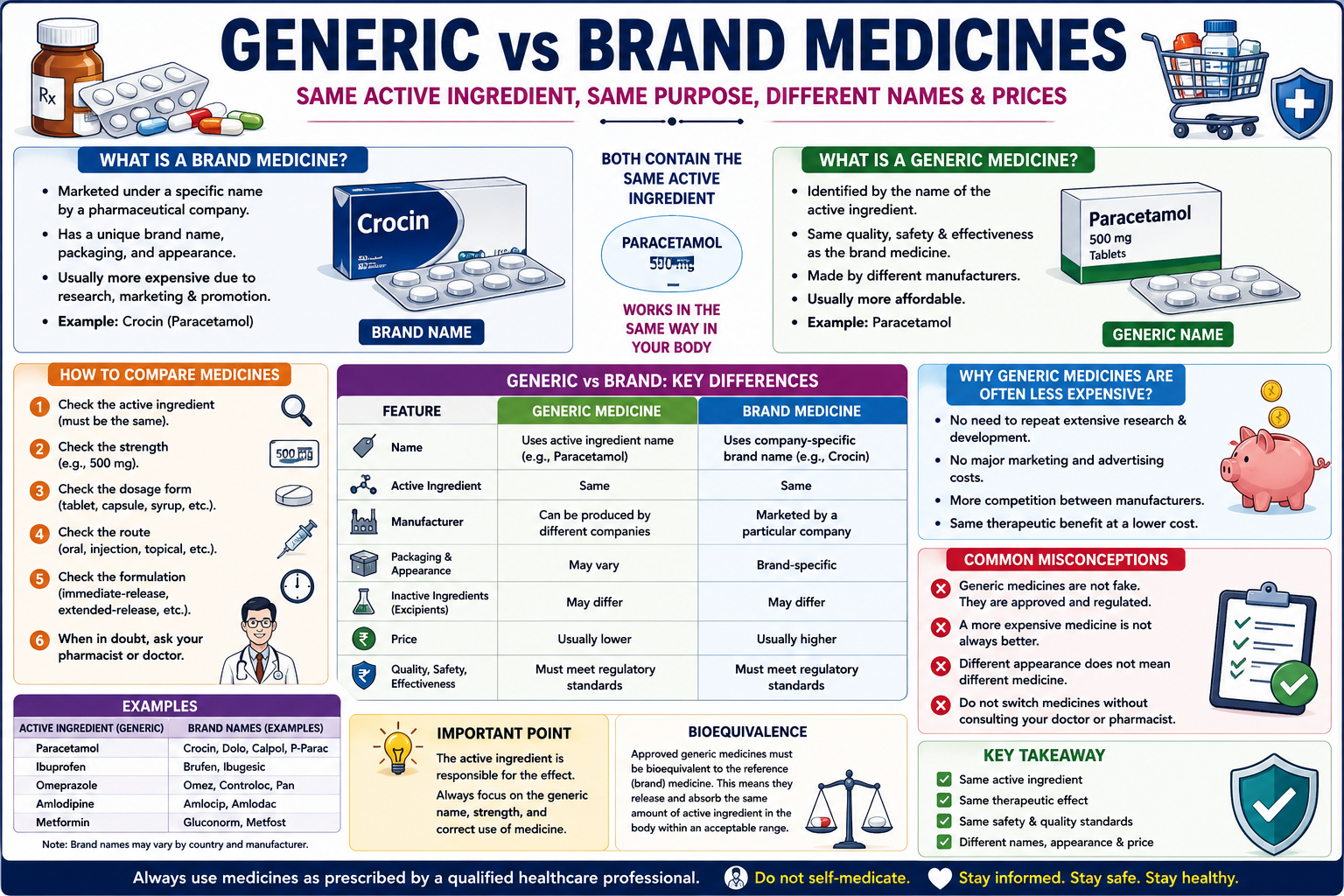
When you visit a pharmacy, you may see medicines available under different names and prices. Some medicines are sold using a brand name, while others are available using their generic name.
Understanding the difference between generic and brand medicines is an important part of pharmacology and healthcare education.
Although the names, appearance, packaging, and price may be different, a generic medicine can contain the same active ingredient as the corresponding brand-name medicine.
In this guide, we will explain what generic and brand medicines are, how they differ, and what medical students should understand about them.
Important: Medicine selection and treatment decisions should be made by a qualified healthcare professional. Do not change, stop, or substitute a prescribed medicine without appropriate medical advice.
What Is a Brand Medicine?
A brand medicine is a medicine marketed under a specific name by a pharmaceutical company.
The company that develops a medicine may market it using a distinctive brand name.
For example, a medicine containing paracetamol may be sold under different brand names by different manufacturers.
The brand name is usually designed to make the product recognizable in the market.
Brand medicines may have:
- A specific brand name
- Distinctive packaging
- Different tablet or capsule appearance
- Marketing and promotional materials
- A particular manufacturer
The active ingredient remains the key component responsible for the intended therapeutic effect.
What Is a Generic Medicine?
A generic medicine is generally identified by the name of its active pharmaceutical ingredient rather than a particular brand name.
For example:
Paracetamol is the generic name of an active medicine commonly used for pain and fever.
A generic product containing paracetamol may be manufactured by different pharmaceutical companies.
Generic medicines are generally expected to meet applicable regulatory standards for quality, safety, and effectiveness.
Generic vs Brand: The Basic Difference
The easiest way to understand the difference is to compare the names and presentation.
| Feature | Generic Medicine | Brand Medicine |
|---|---|---|
| Name | Usually uses the active ingredient name | Uses a company-specific brand name |
| Active ingredient | Same as the corresponding reference medicine | Contains the active ingredient |
| Manufacturer | Can be produced by different manufacturers | Marketed by a particular company |
| Packaging | Manufacturer-specific | Brand-specific |
| Appearance | May differ | Brand-specific |
| Price | Often lower | May be higher |
| Inactive ingredients | May differ | May differ |
| Regulatory requirements | Must meet applicable standards | Must meet applicable standards |
The exact requirements for generic medicines vary according to the regulatory authority and country.
Are Generic Medicines the Same as Brand Medicines?
For an approved generic medicine, the important consideration is that it meets the regulatory requirements for the relevant reference medicine.
Generic medicines generally contain the same active ingredient and are intended to provide the same therapeutic effect when used appropriately.
However, the medicine may look different because manufacturers can use different:
- Colors
- Shapes
- Fillers
- Binders
- Coatings
- Flavoring agents
These differences do not necessarily mean that the medicine works differently.
What Is an Active Ingredient?
The active ingredient is the component of a medicine responsible for its intended pharmacological effect.
For example:
Generic name: Paracetamol
A manufacturer may sell a paracetamol-containing medicine under its own brand name.
The brand name can change from manufacturer to manufacturer, but the active ingredient remains paracetamol.
Understanding active ingredients is therefore more useful than memorizing brand names alone when studying pharmacology.
What Are Inactive Ingredients?
Medicines also contain ingredients that do not provide the primary therapeutic effect.
These may be used for:
- Tablet formation
- Stability
- Flavor
- Color
- Coating
- Preservation
- Manufacturing
These are often called inactive ingredients or excipients.
The excipients can differ between manufacturers.
This is one reason why two medicines containing the same active ingredient may look or taste different.
Why Are Generic Medicines Often Less Expensive?
Generic medicines are often less expensive because manufacturers may not need to repeat all of the original research and development required to bring the original medicine to market.
Once applicable exclusivity or patent protections have ended, other manufacturers may be able to produce approved versions of the medicine.
Competition between manufacturers can also reduce prices.
However, the actual price difference depends on the medicine, manufacturer, country, healthcare system, and pharmacy.
Generic Name vs Brand Name
Consider a simple example:
Active Ingredient
Paracetamol
Generic Product
A manufacturer may sell the medicine using the name:
Paracetamol
Brand Product
Another manufacturer may sell a paracetamol-containing medicine under a specific brand name.
The important point for students is to identify the active ingredient rather than assuming that every different product name represents a completely different medicine.
Why Do Medical Students Need to Learn Generic Names?
Learning generic names is an important part of pharmacology.
A single active ingredient can have multiple brand names.
If a student memorizes only brand names, it can become difficult to recognize that several products contain the same active ingredient.
Learning generic names helps students understand:
- Drug classes
- Mechanisms of action
- Therapeutic uses
- Adverse effects
- Drug interactions
- Contraindications
- Medication safety
For example, instead of memorizing several brand names separately, students can first learn the generic medicine and its pharmacological class.
Can Generic Medicines Look Different?
Yes.
Two approved medicines containing the same active ingredient may have different:
- Colors
- Shapes
- Sizes
- Markings
- Packaging
- Tablet coatings
This does not automatically indicate a difference in therapeutic effect.
Always check the medicine label and prescription information rather than identifying a medicine only by its appearance.
Can Inactive Ingredients Be Different?
Yes.
Generic and brand medicines may contain different excipients.
For most patients, these differences are not clinically significant. However, certain individuals may have sensitivities or allergies to particular ingredients.
If a patient has experienced a reaction to a particular medicine, they should inform their healthcare professional or pharmacist.
What Does Bioequivalence Mean?
Bioequivalence is an important concept when discussing generic medicines.
In simple terms, an approved generic medicine must generally demonstrate that the active ingredient becomes available in the body in a sufficiently comparable manner to the reference medicine according to the applicable regulatory standards.
This helps support the expectation that the generic medicine will provide the intended therapeutic effect.
The exact regulatory requirements and terminology can differ between countries.
Generic Medicines and Drug Safety
Whether a medicine is generic or brand-name, safe use requires attention to:
- Correct medicine
- Correct dose
- Correct route
- Correct timing
- Allergies
- Drug interactions
- Patient-specific conditions
- Expiry date
- Storage requirements
A lower price does not mean that a medicine should be used without appropriate medical guidance.
Common Misconceptions
Myth 1: Generic Medicines Are Fake Medicines
False.
Approved generic medicines are regulated medicines and must meet applicable quality and safety requirements.
Myth 2: A More Expensive Medicine Is Always Better
Not necessarily.
Price alone does not determine the therapeutic effectiveness of a medicine.
Myth 3: Different Appearance Means Different Medicine
Not necessarily.
Different manufacturers may use different colors, shapes, coatings, or packaging.
The active ingredient and strength should be checked.
Myth 4: Generic and Brand Medicines Always Have Identical Ingredients
Not exactly.
The active ingredient is generally the same for an approved generic corresponding to a reference medicine, but inactive ingredients may differ.
Myth 5: Patients Can Switch Medicines Without Checking
Not always.
Even when medicines contain the same active ingredient, patients should follow their prescription and consult a healthcare professional or pharmacist before making substitutions, especially for medicines requiring close monitoring or having a narrow therapeutic index.
How to Compare a Generic and Brand Medicine
When comparing two medicines, check:
1. Active Ingredient
Is the active ingredient the same?
2. Strength
For example:
500 mg
A different strength is not automatically interchangeable.
3. Dosage Form
Check whether it is:
- Tablet
- Capsule
- Syrup
- Injection
- Cream
- Extended-release formulation
4. Route of Administration
Check whether the medicine is intended for:
- Oral use
- Injection
- Topical use
- Inhalation
- Other routes
5. Formulation
Some medicines have modified-release or other specialized formulations that require particular attention.
6. Professional Guidance
When there is uncertainty, confirm the substitution with a qualified pharmacist or healthcare professional.
Generic vs Brand: A Simple Example
Imagine a patient is prescribed a medicine containing:
Active ingredient: Medicine X
Strength: 500 mg
A brand manufacturer may sell it under:
Brand Name A
Another approved manufacturer may sell the same active ingredient as:
Medicine X 500 mg
The packaging and tablet appearance may be different.
The important comparison is not simply the name. Healthcare professionals consider the active ingredient, strength, formulation, route, and regulatory status.
What Should Healthcare Students Remember?
A useful way to remember the concept is:
Brand name = Marketing name
Generic name = Active medicine name
Active ingredient = Therapeutic component
Excipients = Other ingredients used to formulate the medicine
Bioequivalence = Evidence supporting comparable drug exposure according to regulatory requirements
This framework makes it easier to understand medication names during clinical training.
Conclusion
Generic and brand medicines can have different names, packaging, appearance, and prices, but an approved generic medicine is designed to meet the applicable regulatory requirements for its reference medicine.
For medical and healthcare students, learning generic names and active ingredients is particularly important because one medicine may be sold under many different brand names.
When comparing medicines, always consider the active ingredient, strength, dosage form, route, formulation, and professional guidance rather than relying only on the brand name or appearance.
Understanding generic and brand medicines helps healthcare students communicate more clearly, recognize medications accurately, and develop safer medication practices.